I’ve always had an affinity for voices.
While many people draw desire from the aesthetics of others, I can’t help but feel compelled to advocate for aural beauty.
How is it that we can identify someone so distinctly through the sound of their voice?
This intricate blend of tone, frequency, amplitude, waveform, pitch, volume, and timbre is so unique that it can be likened to the concept of a fingerprint – no two are alike.
I’ve come to realize that it’s not just the sound of a voice that is so enthralling – it’s the mannerisms as well.
It’s in the distinctive style and habitual gestures of someone’s voice that make it truly one-of-a-kind. The way a person pronounces and articulates a word can offer clues about their origins, experiences, and aspirations.
The act of speaking, in itself, can be endlessly captivating – the dexterity of the tongue, the subtle smacking of lips, and the force of breath.
Deep within the recesses of your lungs, the process of speaking commences. Air begins to exhale, gently passing over your vocal cords, which react to create a resonant vibration that builds in intensity. Then comes the tension, the unique amount of which resides in our voice box and determines our pitch. Our respiratory system takes control of frequency and volume, compelling sound to emerge. Our entire oral apparatus – tongue, lips, and teeth – works in harmony to shape the emitted sound.
There I was, in a dimly lit room, surrounded by strangers, waiting for someone. My astigmatism made it difficult for me to see even in direct light, let alone in a hazy room like this.
Then I heard him – a clear sign that he had arrived. He called my name in a way that only he could. I still couldn’t see him, but I knew he was there. A hand landed on my shoulder from behind, and I closed my eyes. He leaned in and whispered in my ear, “Hey trouble.”
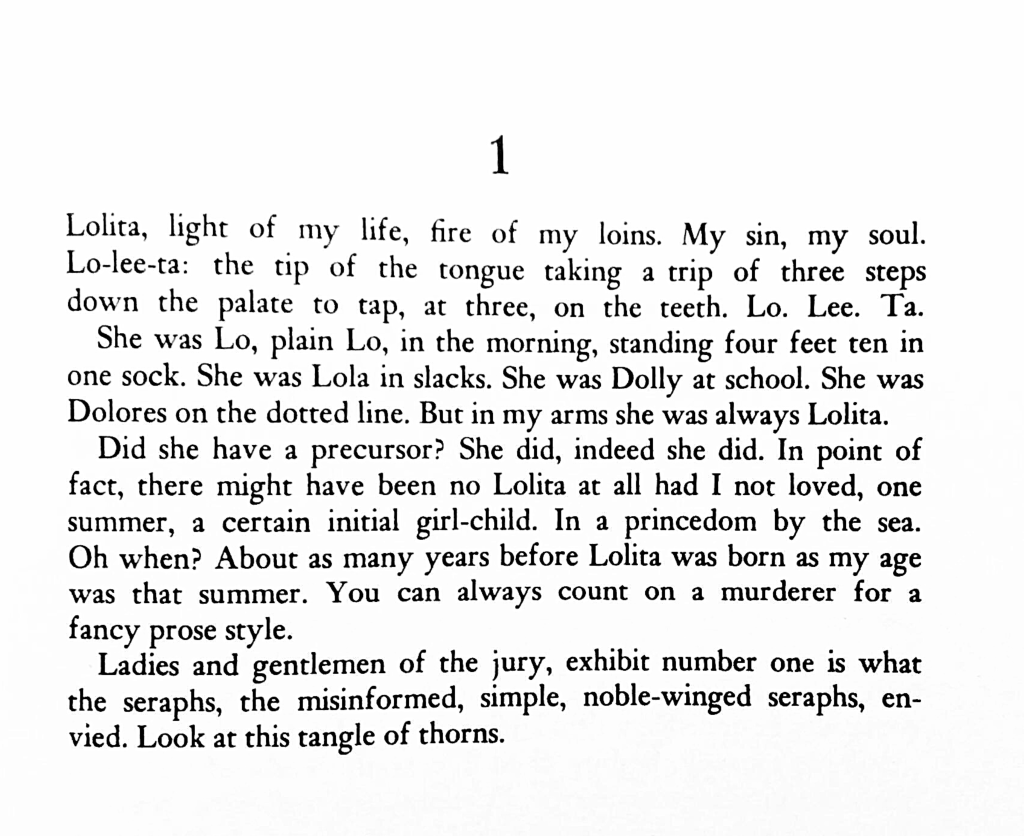
With my eyes closed, I heard the voice of my favorite author, Nabokov, in my head, reciting the opening paragraph of “Lolita”: “Lo-lee-ta: the tip of the tongue taking a trip of three steps down the palate to tap, at three, on the teeth. Lo. Lee. Ta.”
I heard the tap of his words, the ‘T’ and ‘L’ echoing in my mind, envisioning how the sounds were formed in his mouth – the very cognition of his words – and I was utterly mesmerized.
This primary mode of communication is far more intricate than we often acknowledge, shrouded in mystery and deserving of much more recognition than it typically receives
 Catalogue of Thoughts